Alessandro Staniscia
134c03362c
* Refactor GitHub Actions workflows for build, documentation, and linting

- Consolidated build logic into reusable workflows (`task-build.yml` and `task-docs.yml`) to reduce duplication across multiple workflows.
- Introduced `environments.json` to centralize the list of PlatformIO build environments, improving maintainability and clarity.
- Updated `build.yml` and `build_and_docs_to_dev.yml` to utilize the new reusable workflows and environment definitions.
- Enhanced `release.yml` to streamline the release process and integrate documentation generation.
- Created reusable linting workflow (`task-lint.yml`) to standardize code formatting checks across the repository.
- Simplified manual documentation workflow by leveraging the new reusable documentation workflow.
- Improved artifact management and retention policies across workflows.
- Updated dependencies and versions in workflows to ensure compatibility and performance.

* CI/CD pipeline agnostic of Workflow Engine and integrated on github actions

- Implemented ci.sh for orchestrating the complete build pipeline.
- Created ci_00_config.sh for centralized configuration of build scripts.
- Created ci_build_firmware.sh for building firmware for specified PlatformIO environments.
- Created ci_prepare_artifacts.sh for preparing firmware artifacts for upload or deployment.
- Created ci_set_version.sh for updating version tags in firmware configuration files.
- Created ci_build.sh to orchestrate the complete build pipeline.
- Created ci_qa.sh for code linting and formatting checks using clang-format.
- Created ci_site.sh for building and deploying VuePress documentation with version management.
- Implemented checks for required tools and dependencies in the new scripts.
- Updated common_wu.py, compressFirmware.py, gen_wu.py, generate_board_docs.py, and prepare_deploy.sh with descriptive comments.

Refactor CI/CD scripts for improved modularity and clarity

- Consolidated build steps in task-build.yml to utilize ci.sh for version tagging, building, and artifact preparation.
- Updated task-lint.yml to use ci.sh for code formatting checks instead of ci_qa.sh.
- Enhanced CI_SCRIPTS.md documentation to reflect changes in script usage, command structure, and output organization.
- Improved internal scripts for better error handling and logging.
- Streamlined the output structure for build artifacts and documentation.


OpenMQTTGateway aims to unify various technologies and protocols into a single firmware. This reduces the need for multiple physical bridges and streamlines diverse technologies under the widely-used MQTT protocol.
Sponsors

Documentation
The documentation is here
The reference sheet, with the list of all functions, pinouts is here
Upload
Upload OpenMQTTGateway directly from the upload page (no additional software required) or build your own configuration with PlatformIO.
Using OpenMQTTGateway ?
Support open-source development through sponsorship and gain exclusive access to our private forum. Your questions, issues, and feature requests will receive priority attention, plus you'll gain insider access to our roadmap.

Products powered by OpenMQTTGateway
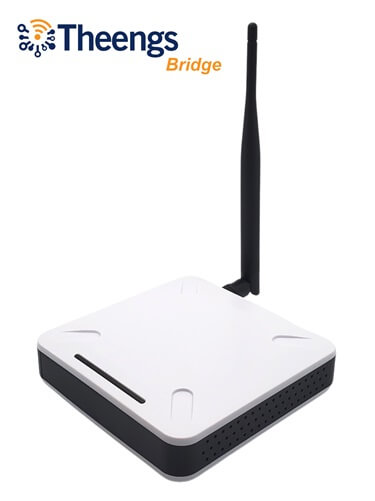
Theengs Bridge, Bluetooth gateway (BLE) with external antenna
Theengs bridge is a powerfull BLE to MQTT gateway for over 100 sensors. Equipped with an Ethernet port, and external antenna, ensuring an enhanced range for your BLE sensors. It supports also WiFi connectivity.
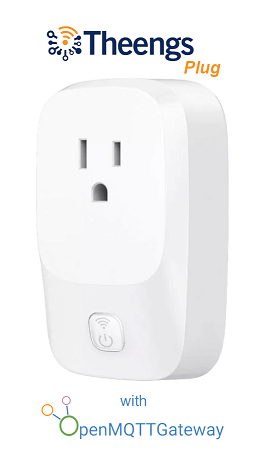
Theengs Plug, Bluetooth gateway (BLE) gateway and Smart Plug
Theengs plug brings the following features:
- BLE to MQTT gateway, tens of Bluetooth devices supported thanks to Theengs Decoder library. The plug uses an ESP32 acting as a BLE to Wifi gateway to scan, decode and forward the data of the nearby sensors,
- Smart plug that can be controlled remotely,
- Energy consumption monitoring,
- Device tracker,
- Presence detection (beta),
- Local connectivity first.
Support the project by purchasing the Theengs bridge or the Theengs plug
Compatible items
-
List of supported devices, door/window sensors, PIR sensors, smoke detectors, weather stations...
-
List of compatible boards (Off the shelf or DIY) is available, RF Bridge, IR, BLE gateways...
Running on a computer If you want to use the BLE decoding capabilities of OpenMQTTGateway with a Raspberry Pi, Windows or Unix PC you can now leverage Theengs Gateway.
- List of compatible components to build your gateway, DHT, RF, IR emitters and receivers...
Compatible controllers, saas or software
Contributors ✨
Thanks goes to these wonderful people who helped OpenMQTTGateway on Github and to the users contributions into the community.
Support
For Questions or Support please don't open an issue, first go to the docs and if you don't find your answer there, you can post your question in the community forum
Help
If you like the project and/or used it please consider supporting it! It can be done in different ways:
- Helping other users in the community
- Contribute to the code or the documentation
- Buy devices, boards or parts from the compatible web site, the devices and parts linked use affiliated links.
- Donate or sponsor the project developers
- Make a video or a blog article about what you have done with OpenMQTTGateway and share it to the community
Media
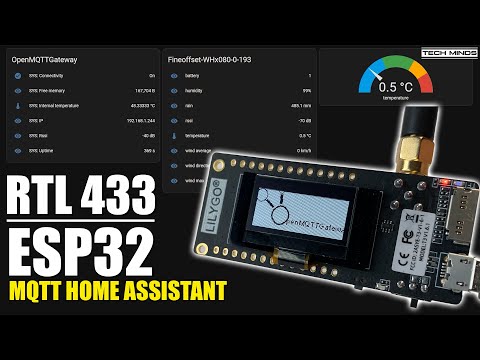
- Hackaday - ARDUINO LIBRARY BRINGS RTL_433 TO THE ESP32
- CNX Software - 433 MHz is not dead! Using an ESP32 board with LoRa module to talk to 433 MHz sensors
- RTL_433 PORTED TO ESP32 MICROCONTROLLERS WITH CC1101 OR SX127X TRANSCEIVER CHIPS
- Using low-cost wireless sensors in the unlicensed bands
- SMART PLUG ESP32 OPENMQTTGATEWAY SERVING AS AN BLE MQTT GATEWAY AND A POWER METER
Theengs Plug

433Mhz and BLE

BLE
433Mhz
LORA